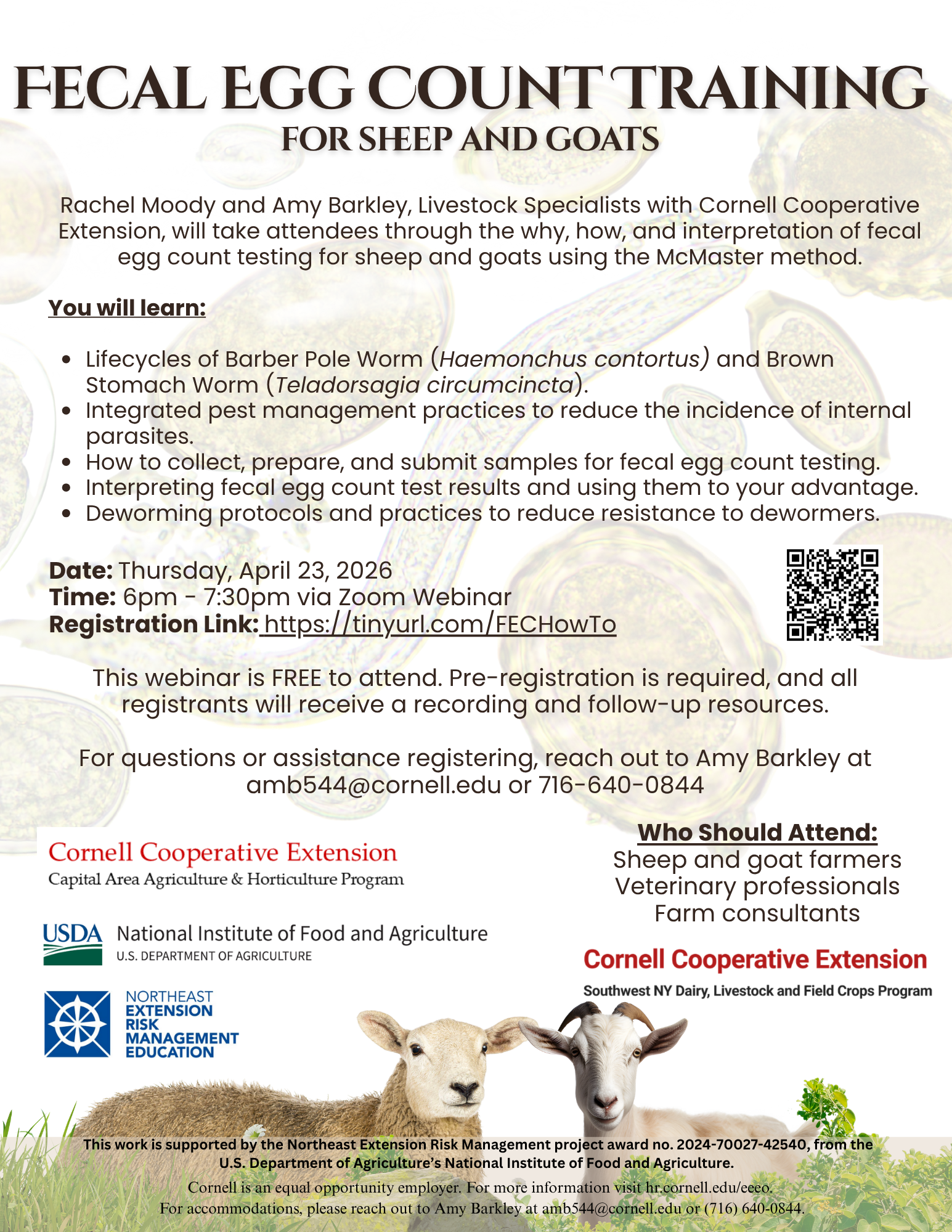
Learn why and how performing fecal egg count tests on sheep and goats is a useful practice in a whole farm pest management program for internal parasites.
Rachel Moody and Amy Barkley, Livestock Specialists with Cornell Cooperative Extension, invite farmers, veterinary professionals, and farm consultants to learn the why, how, and interpretation of fecal egg count testing for sheep and goats using the McMaster method. This methodology helps farmers to understand the internal parasite burdens in their small ruminants to help them make informed decisions on which animals to deworm, breed, or remove from the herd. Using this method in combination with other tests such as FAMACHA and fecal egg count reduction tests can help you determine if a particular dewormer is still effective on your farm.
This class will take attendees through the lifecycles of the two most financially impactful parasites in our pasture systems: Brown Stomach Worm and Barber Pole Worm. Understanding their lifecycles will make way for better designing pasture-based systems to reduce parasite burdens. Even with the best management, there are times when performing fecal egg counts on specific animals is advantageous and knowing how to collect and submit samples as well as interpreting the results with the right lens helps make better management decisions for the whole flock or herd.
Individuals attending this training will learn about common parasite lifecycles; integrated pest management practices; collecting and submitting samples for testing; interpreting fecal egg count test results; & deworming protocols and practices to reduce parasite resistance.
The class will be held on Thursday, April 23, 2026, from 6pm – 7:30pm. It will be taught as a webinar over Zoom and is free to attend. Pre-registration is required, and all registrants will receive a recording and follow-up resources. For questions or assistance registering, visit https://tinyurl.com/FECHowTo or contact Amy Barkley at 716-640-0844 or amb544 [at] cornell.edu.
This work is supported by the Northeast Extension Risk Management project award no. 2024-70027-42540, from the U.S. Department of Agriculture’s National Institute of Food and Agriculture.